Backlink Indexing Service: The Complete Guide to Getting Your Links Indexed
Struggling with unindexed backlinks? Learn how a backlink indexing service works, why links get skipped, and the fastest way to get them indexed in 2026.
By Liton Islam
You did the hard part. You landed a guest post on a relevant blog, earned a mention from a niche publication, or built a link through outreach that actually took weeks to close. Then months go by and that backlink still isn't showing up in Google's index. It's not passing any authority, it's not helping your rankings, and it's basically invisible to the algorithm you built it for.
This is one of the most common and most frustrating problems in modern SEO. Google discovers billions of new URLs every day, but it doesn't crawl and index all of them, and it definitely doesn't index them fast. That gap between "the link exists" and "Google has actually indexed it" is exactly what a backlink indexing service is built to close.
In this guide, you'll learn what a backlink indexing service actually does, why so many backlinks never get indexed on their own, how these services work under the hood, the mistakes that waste people's budgets, and a practical step-by-step process you can use starting today.
Key Takeaways
- A backlink indexing service submits your links to search engines through multiple discovery channels so Google finds and crawls them faster.
- Links on new, low-authority, or orphaned pages are the ones most likely to sit unindexed for weeks or months.
- Indexing does not guarantee ranking impact, but an unindexed link can never help your rankings at all.
- The best results come from combining indexing tools with genuinely link-worthy content, not from indexing low-quality spam links.
- Always track indexing status with site: searches, Search Console, or a provider's dashboard rather than assuming a submission worked.
What Is a Backlink Indexing Service?
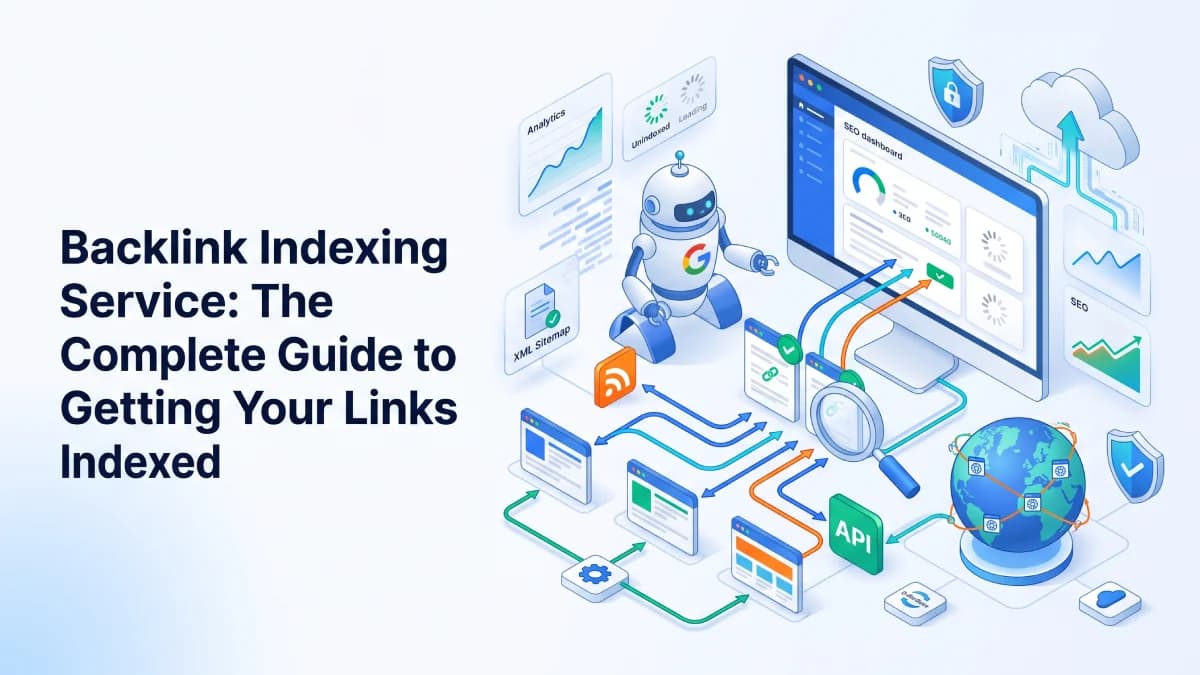
A backlink indexing service is a tool or platform that helps get your backlinks discovered and crawled by search engines like Google and Bing, so those links move from "existing on the web" to "counted in the index." Instead of waiting for a search engine's crawler to stumble onto a page naturally, these services actively push the URL in front of the crawler through methods such as sitemap pings, API submissions, and secondary discovery signals like RSS feeds or social shares.
The goal isn't to manipulate rankings directly. It's to remove the delay and uncertainty between building a link and having that link actually recognized by the search engine, so the SEO value you already earned isn't left on the table.
Why Backlinks Don't Get Indexed Naturally
Google's crawlers work with a limited crawl budget, and they prioritize pages based on signals like domain authority, internal linking, update frequency, and perceived importance. A lot of backlink placements simply don't meet that bar, especially early on.
Limited Crawl Budget
Large sites and low-authority sites alike only get a certain amount of crawler attention. If the page hosting your backlink is deep in a site's structure or sits on a domain Google doesn't prioritize, it can take a long time before a crawler even visits it.
New or Low-Authority Hosting Pages
A brand-new blog post on a small site has to earn its own indexing first. If the host page itself is barely indexed, the backlink sitting inside it is even less likely to be picked up quickly.
Orphan Pages With No Internal Links
If the page containing your backlink isn't linked from anywhere else on that site, and isn't in an updated sitemap, it's effectively invisible to crawlers except through external discovery.
Nofollow, Noindex, or Blocked Resources
Some placements carry a nofollow attribute, a noindex tag, or a robots.txt block that either limits the link's SEO value or prevents the page from being indexed at all. It's worth auditing this before assuming an indexing issue is the whole story.
Thin or Duplicate Content
Pages with very little unique content, or content that closely mirrors other pages, are frequently deprioritized or excluded from the index during quality filtering.
How Backlink Indexing Services Actually Work
Reputable providers combine several discovery channels rather than relying on one trick. The exact mix varies by provider, but the common building blocks include:
Sitemap and Ping Submission
URLs are added to dynamic XML sitemaps that are pinged to search engines, giving crawlers a structured, low-friction path to the page.
Search Console API and IndexNow Submission
Where supported, URLs are submitted directly through official APIs such as Google's Indexing API (primarily intended for job postings and livestreams, though some providers test it broadly) and Microsoft's IndexNow protocol, which Bing and several other engines support directly.
Secondary Discovery Signals
Some services distribute the URL through RSS pings, web 2.0 properties, or social signal networks. These don't directly index a page, but they create additional crawl paths that can speed up natural discovery.
Contextual Link Layering
More advanced setups place your target URL inside a secondary piece of content on an already well-indexed page, giving crawlers a strong, already-trusted path straight to your link.
Benefits of Using a Backlink Indexing Service
- Protects the value of links you already paid for or worked hard to earn through outreach.
- Shortens the gap between publishing a link and seeing any potential ranking benefit.
- Gives you visibility into which links are actually indexed instead of guessing.
- Frees up hours that would otherwise go into manual sitemap pings and resubmissions.
- Scales well when you're managing indexing across dozens or hundreds of links per month.
Common Mistakes to Avoid
- Submitting spammy or low-quality links and expecting indexing alone to make them valuable.
- Never checking whether the link is nofollow or the host page is noindexed before troubleshooting further.
- Treating indexing as a ranking guarantee rather than a prerequisite for any ranking impact at all.
- Submitting the same batch of URLs to multiple tools simultaneously, which wastes budget and can look like a spam pattern.
- Ignoring Search Console's Page Indexing report, which often already explains why a URL was excluded.
Best Practices for Faster Indexing
- Prioritize indexing for links on genuinely relevant, well-written pages, not filler content.
- Keep an internal record of every backlink URL, the date it was submitted, and its current index status.
- Pair indexing submissions with at least one legitimate secondary signal, like a social share or a mention in a newsletter.
- Recheck index status after 1–2 weeks before resubmitting, since indexing can lag even after a successful crawl.
- Keep your own site's technical SEO clean, since a healthy crawl budget on your own domain also helps pages that link out to you get revisited.
Step-by-Step: Getting Your Backlinks Indexed
- Build a spreadsheet of every backlink URL you want indexed, including the anchor text and placement date.
- Check each URL for nofollow tags, noindex meta tags, or robots.txt blocks before submitting anything.
- Submit eligible URLs through a reputable backlink indexing service or the relevant official API.
- Wait 5–10 days, then verify indexing status using a site: search, Search Console, or your provider's dashboard.
- Resubmit only the URLs that are still unindexed, and investigate host-page quality if the same URL keeps failing.
- Log the final outcome so you can spot patterns in which types of placements consistently index quickly versus slowly.
A Real-World Example
Picture an affiliate marketer who secured 40 guest post backlinks across small-to-midsize niche blogs over a quarter. Two months later, a Search Console crawl-stats check shows only about 60% of those links live on pages that are actually indexed. Rather than re-doing the outreach, the marketer runs the unindexed URLs through a backlink indexing service, rechecks status after ten days, and finds the number climbing to roughly 85%. The remaining unindexed links turn out to sit on pages with a noindex tag left over from a client's staging site, an issue no indexing tool could have fixed anyway.
Manual vs. Indexing Service vs. DIY Tools
|
Factor |
Manual Indexing |
Backlink Indexing Service |
Free DIY Tools |
|
Time investment |
High (hours per batch) |
Low (submit and forget) |
Medium |
|
Success rate on hard-to-index links |
Low |
High |
Low to medium |
|
Scalability |
Poor beyond a handful of URLs |
Built for bulk campaigns |
Limited by quotas |
|
Reporting / proof of indexing |
None built-in |
Dashboard with status logs |
Basic or none |
|
Cost |
Free (but time-costly) |
Paid, usually per-URL or subscription |
Free or freemium |
|
Risk of spammy signals |
Low if done carefully |
Low with a reputable provider |
Varies widely |
Pros and Cons
|
Pros |
Cons |
|
Saves hours of manual submission work |
Ongoing cost if you index large volumes monthly |
|
Improves odds that valuable links pass ranking signals |
Not every provider discloses its exact method |
|
Useful for tracking which links Google has actually crawled |
Indexing is never 100% guaranteed for any tool |
|
Works well alongside guest posts and PBN-style link building |
Overuse on very low-quality links won't fix a bad backlink profile |
Expert Tips
- Treat indexing tools as an accelerant for good links, not a fix for bad ones — the underlying link quality still matters most.
- Cross-check indexing claims from any provider against your own Search Console data rather than trusting a dashboard alone.
- Batch submissions by priority: high-value editorial links first, lower-priority directory or profile links later.
- Revisit your internal linking structure periodically — pages linked from your own indexed content get crawled more consistently.
Frequently Asked Questions
What is a backlink indexing service?
It's a tool that helps search engines discover and crawl the pages containing your backlinks faster, using methods like sitemap pings, API submissions, and secondary discovery signals, instead of waiting for organic crawler discovery.
How long does it normally take Google to index a new backlink?
It varies widely, from a few hours on an established, frequently crawled domain to several weeks or months on a small or new site. There's no fixed timeline, which is exactly why indexing tools exist.
Can a backlink indexing service guarantee 100% indexing?
No legitimate provider can guarantee this. Google makes the final indexing decision based on its own quality and relevance signals, so these tools improve the odds and speed of discovery rather than forcing an outcome.
Is using a backlink indexing service against Google's guidelines?
Submitting legitimate URLs through official channels like sitemaps or the IndexNow protocol is standard practice. Problems arise only when the underlying links themselves are spammy or manipulative, not from the act of requesting indexing.
Why would a backlink stay unindexed even after using an indexing service?
Common causes include a noindex tag on the host page, a robots.txt block, extremely thin content on that page, or a domain with such low authority that Google deprioritizes crawling it altogether.
Does indexing a backlink guarantee it will improve my rankings?
No. Indexing is simply a prerequisite; an unindexed link can never pass any ranking value, but an indexed link only helps as much as its authority, relevance, and placement context allow.
What's the difference between Google's Indexing API and IndexNow?
Google's Indexing API is officially intended for job posting and livestream markup, though it's sometimes tested more broadly, while IndexNow is an open protocol supported by Bing and several other engines for submitting any updated or new URL.
How can I check if my backlink is already indexed?
Search site:example.com/page-url in Google, check the URL Inspection tool in Search Console, or review the reporting dashboard provided by your indexing service.
Are free indexing tools as effective as paid backlink indexing services?
Free tools can work for small volumes, but paid services typically offer more submission channels, better reporting, and more consistent results at scale, which matters once you're managing dozens or hundreds of links.
Should I index every backlink I build?
Prioritize links on genuinely relevant, well-written pages first. Indexing low-quality or irrelevant placements wastes budget and won't meaningfully help your SEO even once discovered.
Conclusion and Next Steps
A backlink indexing service exists to solve a very specific, very common problem: links that are genuinely valuable but invisible to the search engines they're meant to influence. By understanding why backlinks stall in the first place, using a reliable submission process, and pairing that with honest tracking of what's actually indexed, you stop wasting the outreach and content work you've already invested in.
If you're managing more than a handful of links a month and want a straightforward way to submit, track, and confirm indexing status, GetIndexRocket is built exactly for that workflow — start with a small batch, compare your before-and-after indexing rate, and scale from there.